
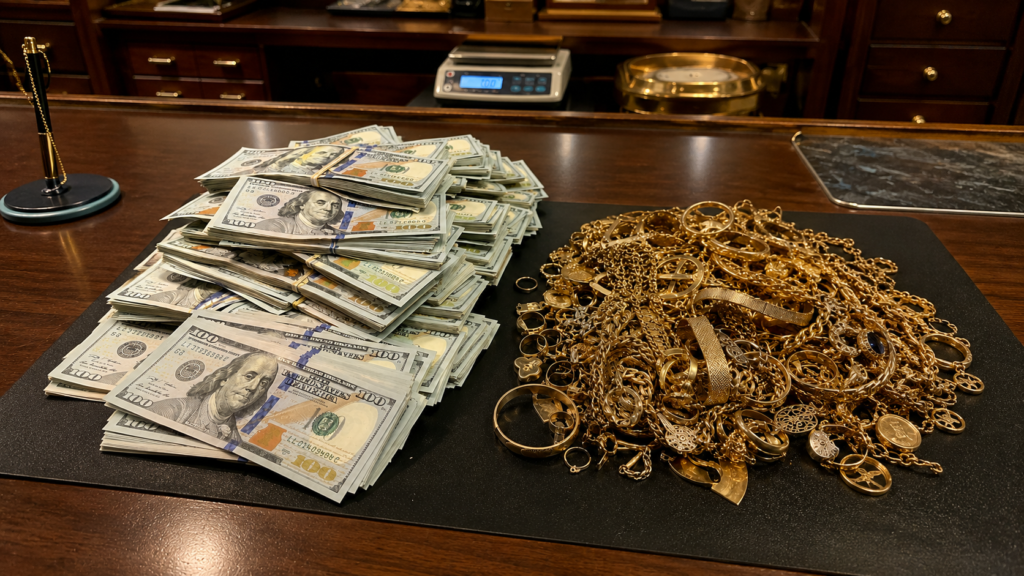
We typically pay 75% to 95% of the precious metal value of gold and platinum jewelry and scrap. The exact percentage depends on the item, quantity, and current market conditions.
Sterling silver, coins, bullion, and diamonds are evaluated differently, which we’ll explain below.
We’re a family-owned shop on Woodruff Road, proudly serving the Upstate since 2012. We believe you should understand your offer before deciding whether to accept it.
That’s why we test and weigh your items in front of you and explain how we arrive at our offer. Your items never leave your sight. You can see the results, ask questions, and decide whether you want to sell.
There’s never any pressure or obligation to sell.
How We Calculate Your Offer
For most gold and platinum jewelry and scrap, four factors help determine what we’ll pay.
1. What your item is made of
We use an XRF analyzer to help identify the metals present at or near the surface of your item without scratching or damaging it.
The testing results help us determine whether we’re looking at gold, platinum, silver, or another metal. Plated or unusually constructed pieces sometimes require additional examination.
2. How much it weighs
We weigh your items in front of you, so you can see the weight for yourself.
3. How pure the metal is
Most jewelry isn’t made from pure gold or platinum. Gold is commonly mixed with other metals to make it stronger.
For example:
| Gold purity | Gold content |
|---|---|
| 24 karat | 99.9% or more |
| 18 karat | 75% |
| 14 karat | 58.3% |
| 10 karat | 41.7% |
Sterling silver is 92.5% silver, although we evaluate sterling purchases separately.
4. Today’s market price
Gold, silver, and platinum prices change throughout the trading day.
We use the current market price, often called the spot price, as the starting point for determining the metal value of your items.
Weight multiplied by purity tells us how much precious metal an item contains. We then use the current spot price to calculate its approximate metal value.
For most gold and platinum jewelry and scrap, our offer typically falls between 75% and 95% of that value.
Why don’t we pay 100% of the metal value?
Buying precious metals involves costs beyond the amount paid to the customer.
Scrap jewelry may need to be sorted, processed, melted, and refined before the precious metal can be recovered and sold. Refineries charge for those services.
We also have testing equipment, employees, and the everyday costs of operating a business.
The difference between the metal value and our purchase price helps cover those expenses and allows us to operate profitably.
We believe customers deserve to understand that difference.
An Example: What Would We Pay for a 14K Gold Chain?
Let’s say you bring us a 14 karat gold chain weighing 20 grams.
For this example, we’ll assume gold is trading at $4,000 per troy ounce.
This is an illustration, not today’s actual gold price. Your offer would be based on current market conditions.
| Step | Calculation | Result |
|---|---|---|
| Gold price per gram | $4,000 ÷ 31.1035 | $128.60 |
| Pure gold content | 20 grams × 58.33% | 11.67 grams |
| Estimated metal value | 11.67 grams × $128.60 | About $1,500 |
| Typical GGS offer range | 75%–95% of metal value | $1,125–$1,425 |
In this example, the chain contains approximately $1,500 worth of gold at the assumed market price.
Our typical purchasing range would put the offer between $1,125 and $1,425.
The actual amount would depend on the item, quantity, and market conditions.
We’ll explain the numbers using the current market price so you understand how we arrived at your offer.
What’s a troy ounce?
Precious metals are measured in troy ounces, which weigh approximately 31.1 grams.
That’s different from the standard ounce used for everyday items, which weighs approximately 28.35 grams.
It’s a common source of confusion, and we’re always happy to explain the difference.
What Affects the Percentage We Pay?
Although our typical range for gold and platinum jewelry and scrap is 75%–95% of metal value, not every transaction is the same.
Several factors can influence the percentage:
- Quantity: Larger amounts of precious metal may qualify for higher purchasing percentages.
- Type of item: Some items are easier to process or resell than others.
- Processing and refining costs: Certain materials require more handling or specialized processing.
- Market conditions: Precious metal prices, demand, and resale markets can change.
We’ll explain the factors that apply to your items before you decide whether to sell.
Why Sterling Silver Is Priced Differently
Sterling silver contains 92.5% silver, but its purchasing percentages are generally lower than those for gold.
There are several reasons.
Silver has a lower dollar value per ounce. Processing and handling costs therefore represent a larger portion of the metal’s value.
Silver items often require more sorting. Flatware, hollowware, and jewelry may include a mixture of sterling silver, silver plate, and other materials that need to be identified individually.
Refining costs and payment timelines differ. Processing silver can involve substantial costs relative to the metal’s value, and refinery settlement times can affect how long a dealer waits to recover its money.
For these reasons, our typical 75%–95% gold and platinum range does not apply to sterling silver.
That doesn’t mean your sterling silver isn’t valuable.
Silver flatware, serving pieces, jewelry, and other sterling items may be worth considerably more than you realize, particularly when silver prices are high.
We’re happy to test your items, explain what you have, and provide an offer.
How We Price Gold and Silver Coins and Bullion
Coins and bullion are evaluated differently from ordinary scrap jewelry.
Their value may depend on several factors, including:
- Current precious metal prices
- The type and weight of the coin or bar
- Current buying and selling premiums
- Market demand
- Condition and possible collector value
For example, a common gold bullion coin may be valued primarily for its gold content and current resale demand.
An older or collectible coin may be worth more than the precious metal it contains.
That’s why we evaluate coins individually rather than automatically treating them as scrap.
How We Evaluate Diamonds and Gemstones
Diamonds and other gemstones are not priced as a percentage of gold or platinum spot value.
We evaluate them separately.
Factors that may affect a diamond’s resale value include its size, cut, color, clarity, condition, and whether it’s natural or lab-grown.
It’s also important to understand that the original retail price of a diamond ring isn’t necessarily what the diamond will bring on the resale market.
When evaluating jewelry containing diamonds or gemstones, we consider the precious metal setting and the stones separately.
We’ll explain what we find and how it affects our offer.
Selling an Estate or Inherited Collection?
Sorting through a loved one’s jewelry, coins, or silver can be overwhelming, especially when you’re not sure what’s valuable.
Some pieces may have significant precious metal content. Others may have collector value or sentimental importance that isn’t reflected in their melt value.
We’re happy to help you understand what you have.
We’ll examine your items, explain their value, and answer your questions.
You don’t have to sell everything, and you don’t have to make a decision during your visit.
If something has sentimental value, take the time you need to decide whether you’re comfortable parting with it.
Frequently Asked Questions
Do I need an appointment?
No appointment is necessary. You’re welcome to visit during our regular business hours:
Monday–Friday: 10 AM–6 PM
Saturday: 10 AM–3 PM
For particularly large collections or estates, calling ahead can be helpful.
Can you tell me what my gold is worth over the phone?
We can explain current market prices and how we calculate our offers. However, to provide an accurate offer for a particular item, we generally need to examine, test, and weigh it in person.
Do I have to sell if I bring something in?
Absolutely not. We’re happy to evaluate your items and explain our offer. Whether you sell is entirely up to you.
Can you test something I’m not planning to sell?
Yes. We can provide XRF testing for customers who simply want to know more about their items. There may be a small fee for testing-only requests. If you’re considering selling, testing as part of our purchasing evaluation is free.
How will I be paid?
Most transactions are completed during the same visit. Smaller purchases can often be paid in cash; larger ones are typically paid by check.
What should I bring?
Bring the items you’d like evaluated and a valid photo ID if you intend to sell.
Visit Greenville Gold & Silver
If you’ve been wondering what your gold, silver, platinum, or coins are worth, we’d be happy to help.
We’ll test your items, explain what we find, and show you how we determine our offer.
No pressure. No obligation. Just straightforward answers.
Greenville Gold & Silver
1637 Woodruff Rd, Greenville, SC 29607
Monday–Friday: 10 AM–6 PM
Saturday: 10 AM–3 PM
864-901-7975
Family-owned and proudly serving the Upstate since 2012.
We welcome customers from Greenville, Greer, Simpsonville, Mauldin, Taylors, Fountain Inn, and throughout Upstate South Carolina.
Come see what your precious metals are worth. We’ll show you the math.